
How to Improve Your Problem-Solving Skills
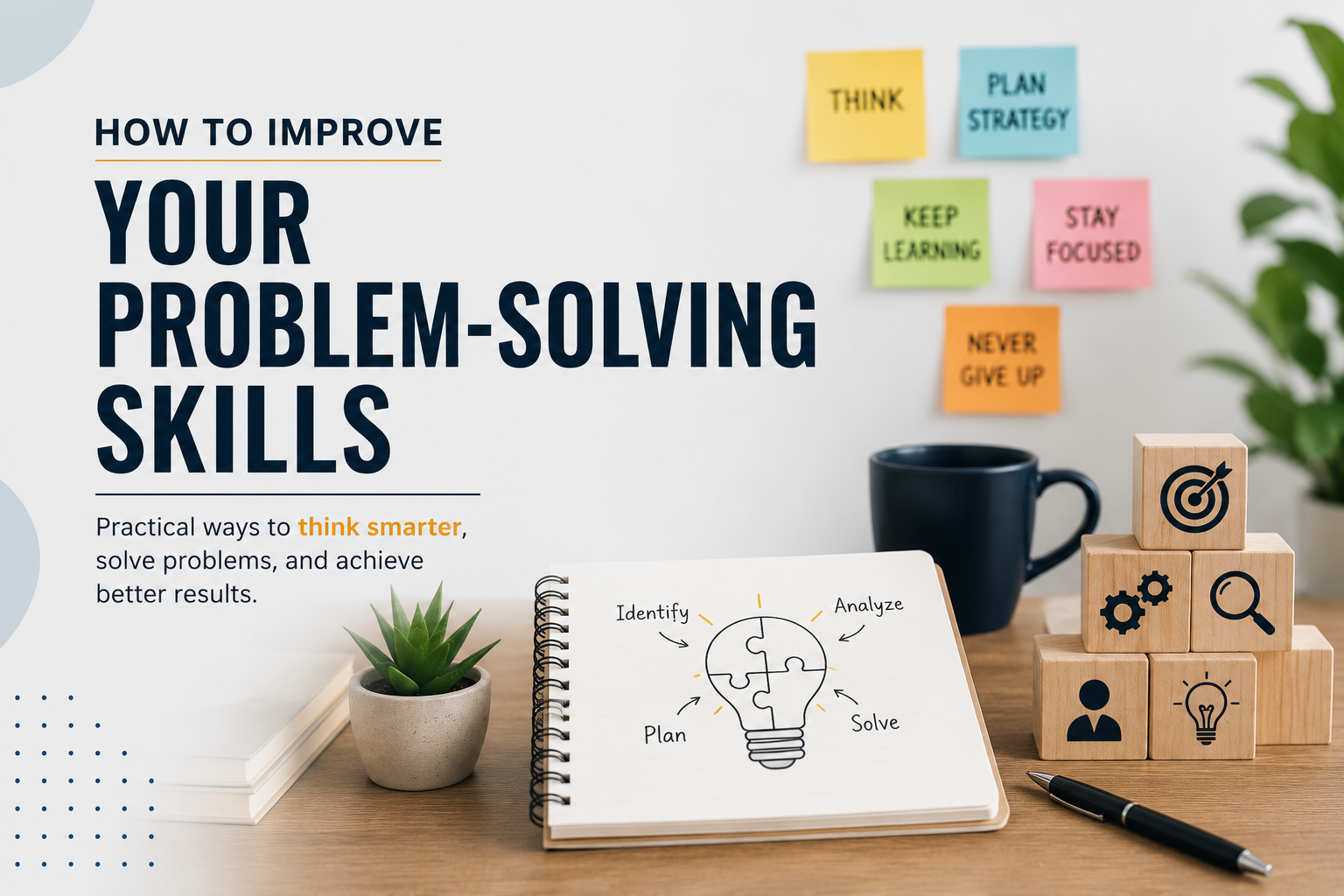
Problem-solving is one of the most sought-after skills in today's workplace. Regardless of your industry or role, employers value professionals who can identify challenges, analyze situations, and develop effective solutions.
Beyond career success, strong problem-solving abilities can improve decision-making, strengthen relationships, and help you navigate everyday challenges with greater confidence.
Problem-solving is built on a combination of skills, including critical thinking, communication, creativity, research, active listening, and decision-making. While some people may naturally excel in these areas, they can also be developed and strengthened over time.
Here are several practical ways to improve your problem-solving skills.
1. Expand Your Knowledge Through Reading
Reading exposes you to new ideas, perspectives, and ways of thinking.
While books specifically focused on problem-solving can be valuable, don't limit yourself to that category. Books on critical thinking, decision-making, psychology, leadership, and systems thinking can help you understand how people approach challenges and make decisions.
The more perspectives you encounter, the more tools you'll have available when facing complex situations.
2. Learn to View Problems from Multiple Perspectives
One of the biggest barriers to effective problem-solving is seeing a situation from only one point of view.
Every challenge can be viewed through different lenses depending on the people involved, the goals being pursued, and the circumstances surrounding it.
When faced with a problem, ask yourself:
• How would a customer view this?
• How would a manager approach it?
• How would a colleague interpret it?
• What opportunities or risks might others see that I don't?
Training yourself to explore multiple viewpoints often reveals solutions that might otherwise go unnoticed.
3. Develop Strong Listening Skills
Effective problem-solvers are often excellent listeners.
Listening helps you gather information, understand concerns, and identify factors that may not be immediately obvious. It also allows you to benefit from the experiences and perspectives of others.
Rather than focusing solely on your own assumptions, make an effort to:
• Ask thoughtful questions
• Listen without interrupting
• Seek clarification when needed
• Consider feedback objectively
Many problems become easier to solve once you fully understand them.
4. Take a Step Back Before Reacting
Sometimes the best way to solve a problem is to create distance from it.
When we're deeply involved in a situation, emotions and pressure can cloud our judgment. Taking time to pause and reflect often leads to better decisions.
This could mean:
• Going for a walk
• Taking a short break
• Discussing the issue with a trusted colleague
• Sleeping on an important decision
Stepping back creates mental space and allows fresh ideas to emerge.
5. Practice Brainstorming Techniques
Brainstorming is a powerful tool for generating ideas and uncovering creative solutions. Whether working independently or as part of a team, brainstorming encourages you to explore possibilities without immediately judging them.
Some effective techniques include:
• Mind mapping
• Free writing
• Word association
• Rapid idea generation
• Question-based brainstorming
The goal is to think beyond obvious solutions and challenge conventional assumptions.
6. Use the “5 Whys” Technique
One of the simplest yet most effective problem-solving methods is the "5 Whys" technique.
When a problem occurs, ask "Why?" repeatedly until you uncover the root cause.
For example:
Problem: Missing project deadlines.
Why? Tasks are taking longer than expected.
Why? Priorities are unclear.
Why? Requirements are not being communicated effectively.
Why? Team meetings lack structure.
Why? There is no defined project management process.
By identifying the underlying cause rather than treating symptoms, you can develop more effective and lasting solutions.
Why Problem-Solving Matters
Strong problem-solving skills help you:
• Make better decisions
• Adapt to change
• Handle challenges confidently
• Work more effectively with others
• Increase your value as a professional
Employers consistently seek individuals who can think critically and contribute solutions rather than simply identify problems.
Final Thoughts
Problem-solving is not a talent reserved for a select few—it's a skill that can be developed through practice, curiosity, and continuous learning.
By reading widely, listening actively, exploring different perspectives, taking time to think, and applying structured problem-solving techniques, you can strengthen your ability to tackle challenges both professionally and personally.
The more you practice, the more confident and effective you'll become when facing complex situations.